Masterplan
1. Executive summary
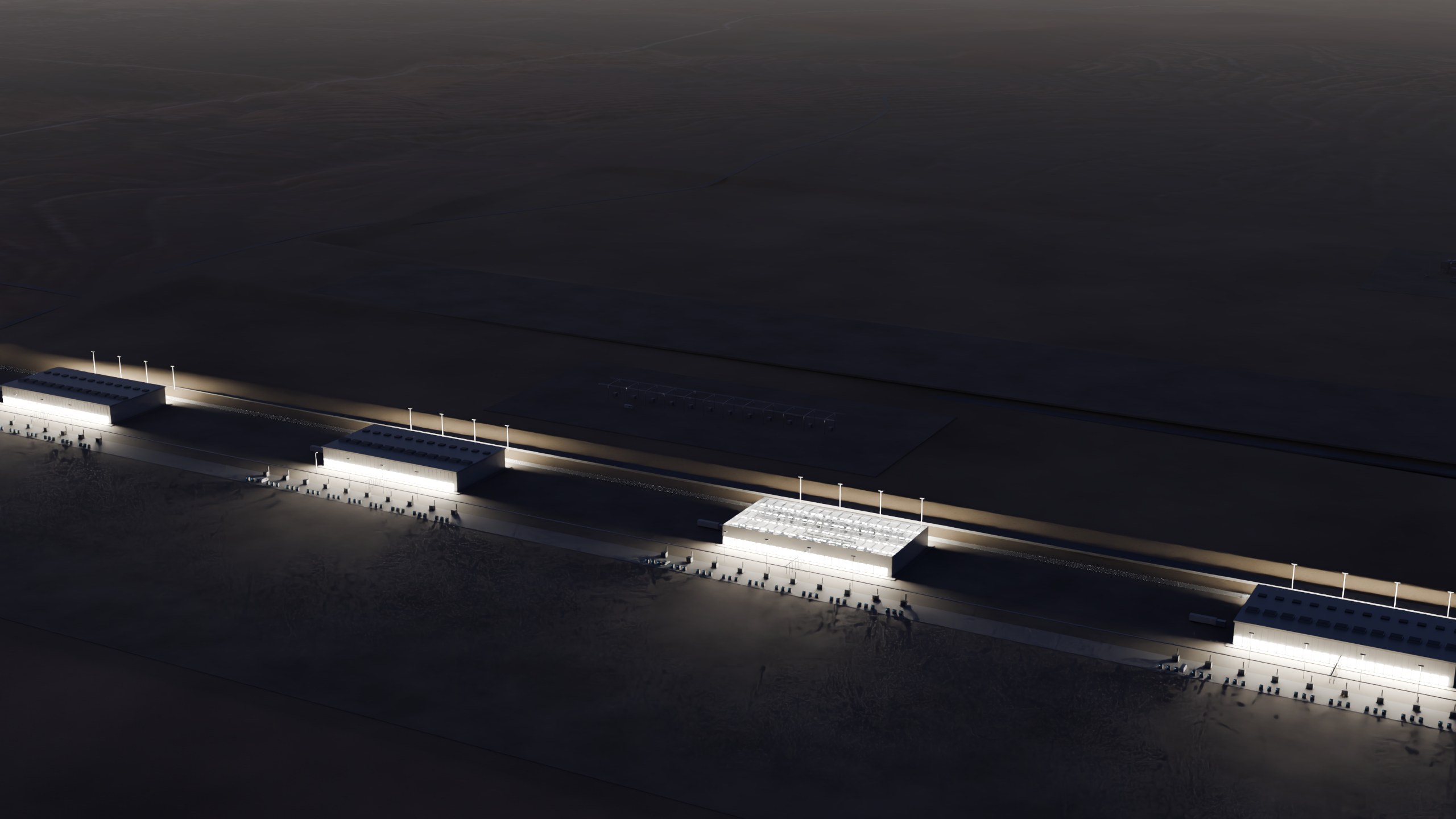
Atlas Phase 2 campus on the northeast block. First power on Palo Duro, without the ERCOT queue.
1.1The question and the answer
Can this ranch host a 350 MW IT training campus, with first power on Palo Duro and without an ERCOT interconnection.
Yes. West Big Field plus Clear Country, 3 electrical islands. First 100 MW is the tranche Palo Duro can fuel on a rental aero bridge. The campus is 16 machines at 26.42 MW each on the design afternoon, a grid-forming battery, dry heat rejection almost all year, and 415 Y/240 V to 1,844 racks. First fire does not use the 345 kV line; that cut-in is Phase 3.
One campus on the flat upland of the northeast block. Power is built on the ranch, not bought from the grid: rented gas turbines fueled by a new 9.5-mile lateral to the Palo Duro pipeline, buffered by batteries, permitted through the standard Texas fast lane before anything runs. The grid connection comes later, as upside. The largest recent US builds went from bare power to hundreds of megawatts of running compute in under a year with this sequence. This site can run the same schedule with the permits done first.
1.2Headline numbers
| Quantity | Value | Kind |
|---|---|---|
| IT MW campus | 350.0 MWConstraint | Constraint |
| First-power IT MW | 100.0 MWPlan | Plan |
| Capex P50 rental (halls, no owned gen) | 5,360.5 $MEstimate | Estimate |
| Capex P50 owned campus | 6,738.1 $MEstimate | Estimate |
| $/MW-IT rental | 15.3 $M/MW-ITEstimate | Estimate |
| $/MW-IT owned | 19.3 $M/MW-ITEstimate | Estimate |
| Campus live P50 | 45.4 monthsEstimate | Estimate |
| Campus live P90 | 52.8 monthsEstimate | Estimate |
| First power P50 | 23.5 monthsEstimate | Estimate |
| PUE | 1.06 ratioCalculated | Calculated |
| PUE, mechanical only | 1.02 ratioCalculated | Calculated |
| WUE | 0.05 L/kWhCalculated | Calculated |
| CUE | 0.59 kgCO2/kWh-ITEstimate | Estimate |
| Availability | 1.00 ratioSelected | Selected |
| Path efficiency | 95.6 %Calculated | Calculated |
Class 4 range on owned-campus capex: $4,717M to $10,107M. Capex excludes GPUs. First 100 MW is a tranche of this campus. Facility load is 372.74 MW.
1.3What this design concludes
Five findings, ordered by how much money moves if they are wrong. Each one is forced by a number, and the number is next to it.
| Finding | The number that forces it | What we do about it |
|---|---|---|
| F1 · The case does not clear at 165 $/kW-month decides FID | DSCR 0.78 against a 1.35 covenant Yield on cost is 4.96% against debt at 7.80%. Every borrowed dollar dilutes the equity return, so more leverage makes this worse rather than better. The problem is the cost basis and the price, not the capital structure. | Either the cost basis comes down about a quarter or the contract prices above current comps. Both move roughly half as much in the realistic case. |
| F2 · Water, not power, is the binding permit decides the site | 116 AF/yr against a 49 AF/yr MAG, 2 times over Coil area cannot reach zero water. Consumption bottoms at about 76 AF/yr (1.5x MAG) around 10x the base field, then rises again: past that point the extra face area wets more air on the hours that still need pads than the tighter approach saves. The residual is the handful of hours above the design dry bulb, where no coil area helps because the ambient is simply hotter than the loop. | Phase 1 lands at 33 AF/yr, inside the 49 AF/yr limit, so first power needs no groundwater fight at all. The permit question arrives with the Phase 2 campus, which buys time to answer it. Read the duration curve rather than the peak. Most of the trim hours need a fraction of the peak, so a partial chiller sized off the curve, with pads kept for the few hours above the loop limit, buys most of the water saving for a fraction of the plant. That hybrid is the recommendation; full mechanical backup is priced here to show what the last drop of water costs. |
| F3 · Nameplate generation was never available decides the plant | 26.4 MW per machine at the 104 F design day against a 34.5 MW ISO rating A fleet sized on the nameplate buys 13 machines. This run needs 16, and the difference shows up on the one afternoon it cannot. | Carry the derated figure into every capex and fuel line. Confirm against a vendor curve at 611 m. |
| F4 · Behind the meter buys the ramp, not the endpoint decides the story | first power 19.5 months ahead of the grid; the campus lands within 2.4 months of it Behind the meter buys first power. First IT lands 19.5 months ahead of the grid path. The full campus still finishes within a few months of a grid date because construction and long-lead equipment set that date, not the interconnection queue. | Islanding starts revenue earlier and hedges a queue position nobody controls. It does not pull the full campus in sooner than a grid path would. |
| F5 · Long-lead equipment, not permitting, sets the date decides the schedule | 35.3% of draws gated by transformer and switchgear delivery PSD and Title V are mandatory at 20.4 times the greenhouse-gas threshold, and were missing from the schedule, but they gate only 2.9% of draws. Construction and delivery dominate. | Buy production slots on option day, ahead of FID. |
1.4The five risks that matter
The 16-inch line is certificated at 80,000 Dth/d. The 2025 open-season results were never published. Palo Duro can fuel first power (~100–133 MW IT), not the 350 MW campus. Campus needs a second tap, compression, and a written capacity answer before P2 FID.
What retires it. A written uncommitted-capacity answer from Producers Midstream / Palo Duro Transmission, then a binding precedent agreement. · Owner / midstream · Before lateral FID
Governor directive 2026-08-03 froze the pipeline. First utility MW is P50 mid-2030. Phase 1 does not wait on this, but grid upside, tenant ‘utility-backed’ language, and later GW scale do.
What retires it. BTM gas is the Phase 1 path. File the week the window reopens. Do not sell a 2028 utility MW. · Counsel / development · Now (path selection) and at queue reopen (filing)
King MAG is 49 AF/yr of fresh. No pump-test in the block. Gypsum water is likely. A WUE guarantee cannot be signed on a desktop band.
What retires it. 2–3 test wells, 72-hour pumps (~$150–300k). Stay dry at the plant regardless; wells only have to cover domestic, humidification, washdown, and fire make-up. · Hydrogeologist · Month 0–3
This run has hundreds of padmounts and PCUs at 40 weeks, none in stock. The 34.5 kV collector is 3 independent sections, so losing one drops about 33% of IT rather than the campus. No closed ties; Uptime Tier III is not claimed.
What retires it. Place xfmr/PCU orders against an approved-alternates list in Phase 0. Closed ties or a ring are a later compile before a tenant SLA that claims concurrent maintainability. · Electrical / procurement · Order in P0; topology in next design freeze
KMZ is not an ALTA. Texas mineral estate is dominant (live permit in the block). Public maps show no long-haul through Dickens/King. A tenant will not close on any of those.
What retires it. ALTA + mineral SUAs + two carrier IRUs (Childress and Lubbock). Single-lateral reads as Tier-2-only. · Land / fiber · Pre-LOI
1.5Decisions requested, and by when
| Decision | By | Why |
|---|---|---|
| Confirm BTM rental-gen as first power, owned aero-equivalent + recip as the 350 MW campus | Now | Locks capex, TTP, and the air-permit story. 100 MW is a tranche. |
| Freeze 350 MW IT campus / 3 116.667 MW zones / NVIDIA VR200 NVL72 (Vera Rubin) / 415 V / adiabatic-assisted dry plant | Now | Hall count, water legal, and MV architecture already hang on these gates. |
| Authorize Palo Duro capacity ask and two fiber IRU conversations | Now | The two commercial gates that can kill the site. |
| Commission the Phase 0 study stack (wells, geotech, H&H, ESA, cultural, ALTA, minerals) | Month 0 | Nothing else is bankable until these return. |
| Place xfmr/PCU approved-alternates RFQ | Month 0–1 | 40-week items; none in stock. |